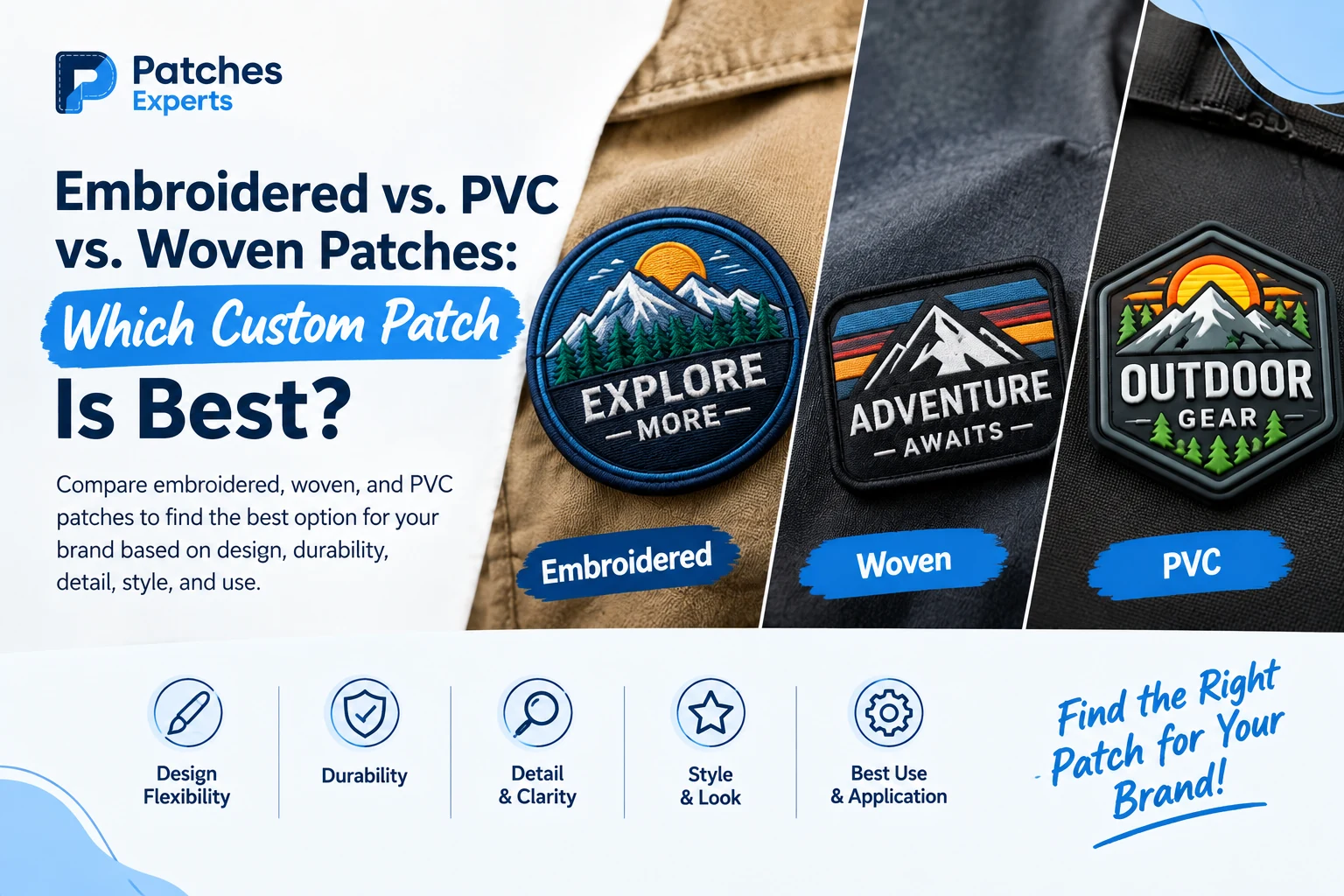
Embroidered vs. PVC vs. Woven Patches: Which Custom Patch Is Best for Your Brand?
You have an awesome logo, great brand identity, and a product that customers simply adore, but even with all these strengths choosing the perfect patch for your product might prove to be difficult. You choose the wrong patch, and you might end up having something that doesn’t reflect your design or is simply ineffective where you will use it. Luckily for you, you don’t have to wonder any longer how to do it.
The right choice of the patch will be determined by several criteria including design, application, performance needs, and the impression that you want to convey with your brand. Let’s find out more about the options that you have to make the right decision.
What Makes One Patch Better Than Another?
No winner is to be found here. Embroidered, woven, and PVC patches are manufactured in a completely different way, and so they solve different problems. This is particularly important for the US market. Embroidered patches were the leading product segment in 2025.
So, how do you know which option makes sense for your brand?
Quick Comparison
| Patch Type | Best Quality | Best For |
| Embroidered | Texture and classic appeal | Jackets, hats, uniforms, heritage brands |
| Woven | Fine detail and small lettering | Fashion, detailed logos, lightweight apparel |
| PVC | Durability and weather resistance | Outdoor, tactical, sports, and technical gear |
Are Embroidered Patches Right for Your Brand?
If you want that familiar, textured patch look, embroidery is hard to beat. Thread is stitched onto a fabric base, creating a raised surface that you can actually see and feel. That texture gives a logo more presence, particularly on jackets, caps, uniforms, bags, and heavier garments. Competitor comparisons consistently identify embroidery as the traditional choice for bold designs and classic branding.
Where Does Embroidery Work Best?
Choose embroidery when you want:
- A traditional or heritage appearance
- Bold logos that need to stand out
- A textured, premium-feeling finish
- Branding for jackets, hats, uniforms, or workwear
- A patch that feels like part of the garment rather than a printed graphic
There is one important catch: tiny details.
Because embroidery uses threads, very small lettering and thin lines can become difficult to read. One current manufacturer comparison suggests embroidered text generally becomes less suitable around the 4 mm range, while woven options can handle text closer to 2 mm.
These are valuable design guidelines but not absolute laws since the final outcome will also be influenced by the artwork used, patch size, and production environment. If your logo features a lengthy tagline in small text, do not just scale down the entire logo to fit. This is usually when the well-designed logo begins to deteriorate.
Could Woven Patches Give Your Logo a Cleaner Look?
Woven patches take a different approach. Instead of stitching the design onto a base, fine threads are woven together to create the artwork. The result is flatter, smoother, and usually better suited to intricate designs.
When Should You Choose Woven?
Woven patches make sense when your design includes:
- Small lettering
- Thin lines
- Detailed symbols
- Intricate logos
- Multiple small design elements
- A lightweight garment where a raised patch may feel too bulky
The biggest advantage is precision. Industry standards currently place the standard thickness of woven patches at about 2 mm in order to be able to read small text, whereas embroidered patches have a standard thickness of approximately 4 mm.
The trade-off is personality. Woven patches are smooth and refined, but they don’t have the raised, tactile character of embroidery. That can actually be an advantage for modern clothing brands. If your identity is clean, minimal, or detail-heavy, a flat woven patch may communicate your style better than a chunky embroidered one.
Is PVC Better When Durability Matters Most?
If your patch is going outdoors, PVC deserves serious consideration. PVC patches are formed and not sewn, giving them a smooth, rubber appearance. This makes them well-suited for situations where water, mud, and harsh conditions are an everyday aspect of their use.
PVC is always chosen by the industry for tactical, outdoor, and technical patches as it doesn’t fray like a textile patch.
Why Might Your Brand Choose PVC?
PVC is a strong fit for:
- Outdoor equipment
- Tactical gear
- Sportswear
- Backpacks
- Work gear
- Technical apparel
- Products exposed to rain or moisture
It also gives you a distinctly modern look. Raised and recessed areas can add depth without relying on thread. But that same look can be a drawback. A PVC patch may feel completely wrong on a vintage denim brand that depends on craftsmanship and heritage. The material isn’t bad, the fit with the brand is the issue.
Which Patch Handles Small Details Best?
For detailed artwork, woven is usually the safest starting point. For bold artwork, embroidered can create more visual impact. For bold graphics that also need a rugged, molded finish, PVC is often the better choice. Think about your logo at its actual finished size, not on your computer screen.
A detailed logo that looks beautiful at 10 inches may become unreadable when reduced to a 2-inch patch. Before placing a large order, reviewing a proof or sample at the intended size can save you from an expensive disappointment. Competitor guides also recommend evaluating artwork at its final dimensions rather than assuming every design will reproduce equally well.
What About the Backing?
Do not neglect the backing simply because you have made up your mind about the material. The method of attaching the patch is what will determine its practicality.
- Sewing: Reliable way to attach it for a long term use.
- Ironing: Quick and effective for many clothing applications.
- Hook and loop: Great when the patches are supposed to be changed.
- Adhesive: Works better in cases of temporary or light applications.
Sometimes no matter how good the material is, it won’t work due to an unsuitable attachment method.
Readers Usually Ask
Which Patch Type Is Better, the Embroidered One or the Woven One?
Well, not always! The embroidered patch will be more textured and classic, while the woven patch is usually better when it comes to text. The design will determine the outcome.
Do PVC Patches Get Wet?
This type of material is very resistant to moisture and water. It can be used outdoors and for tactical purposes.
Which Patch Type Is Best for a Clothing Brand?
It depends on the clothing line. Embroidery suits heritage, streetwear, workwear, and classic styles. Woven works well for clean, detailed, lightweight fashion. PVC fits technical and outdoor-inspired collections.
Can the Same Logo Be Made as All Three Types?
Yes. However, the artwork may need adjustments for each production method. A tiny tagline that works in a woven version may need to be enlarged, simplified, or removed from an embroidered version.
Which Patch Should You Choose for Hats?
Embroidered patches are a classic choice for hats because their raised texture gives logos strong visual presence. Woven patches can be a better option when the logo contains fine details or small lettering.
Conclusion
Choosing the right custom patch comes down to more than just appearance. Your brand style, logo details, application, durability requirements, and preferred attachment method should all influence your decision.
Consider your design at its final size, request a proof or sample when possible, and select the material and backing that best match your product. With the right combination, your custom patch can turn your logo into a memorable and effective part of your brand identity.
Ready to Create Your Perfect Custom Patch?
Have a design in mind? Take the next step with Patches Experts and bring your custom patch idea to life. Get your custom patch started today and give your brand a patch worth remembering.
We help brands turn their logos and designs into custom embroidered, woven, and PVC patches made to match their style, application, and performance needs.